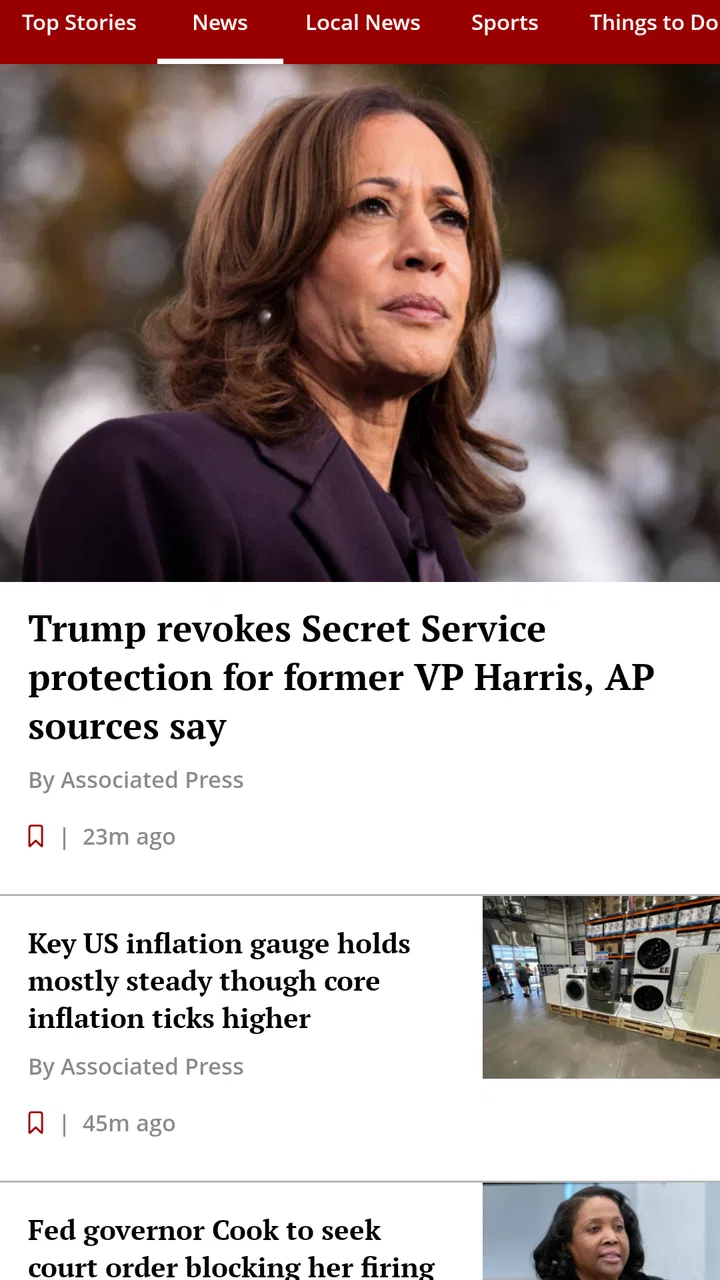
The Press Democrat
- 3.6
- Rating
- 10.00K
- Installs
- Free
- Price

 Analysis by App-foxy
I spent time with The Press Democrat as a mobile news reader, and its appeal became clearest when I treated it as a way to stay connected to local reporting rather than as a replacement for every news source on my phone. Developed by MediaNews Group, Inc., this free News & Magazines app focuses on delivering Press Democrat coverage through a phone-friendly experience, with personalized notifications at the center of its identity. It is most useful when timely local information matters more than having the broadest possible national news selection.
The app is available to everyone and runs on Android devices using version 8.0 or later. It has been around since December 3, 2012, and the current release is version 10.0.60. That history gives it the feel of an established publication app rather than a brand-new experiment, although the experience still depends heavily on how reliable your connection is and how much you want to interact with subscription-related content.
How The Press Democrat feels when the connection is doing the work
The first thing I noticed is that this is a connection-led news experience. Headlines, article content, images, updates, and notifications all make the most sense when the phone can reach the publication’s services. On a strong mobile or Wi-Fi connection, the app feels direct: open it when something is happening, scan the latest items, and follow the story that deserves more attention.
You May Also Like

 Blood Strike: 2.5 Anniversary
Blood Strike’s Loadouts Turn Every Drop Into a Tactical Gamble
A close look at Blood Strike’s custom loadouts: how fast access to signature weapons reshapes its battle royale rhythm, rewards preparation, and narrows the gap between fights.

 Pandora - Music & Podcasts
Pandora’s Music Is Easy to Start, but Harder to Recover
Pandora’s strength is its low-effort path from a seed to a station. Its weak spot is how much confidence it asks you to place in connection, setup, and quiet recovery.

 8 Ball Pool
 Is Built on Rivalries, Rematches, and Routine
A close look at the rivalries, rematches, shared routines, and unanswered safety questions that turn a quick pool match into a persistent mobile community.

 Samsung Music
’s Quiet Strength Is Playing What You Already Own
Its reach comes less from spectacle than from dependable access to a personal library. That simplicity is both the app’s strongest retention engine and its ceiling.

 AccuWeather: Weather Radar
AccuWeather Review: A Quick, Clear Forecast for Everyday Decisions
For everyday plans, the best forecast is the one you can understand quickly. AccuWeather makes rain timing, radar, and local conditions easy to act on, with a few trade-offs.

 Hill Climb Racing
Why Hill Climb Racing Still Turns Crashes Into One More Run
A tiny car, a bumpy hill and one more upgrade: Hill Climb Racing keeps resurfacing because its simple chaos makes every near-miss feel personal.
More From Our News Desk
View All News


That sounds simple, but it changes how I use it compared with a general news aggregator. An aggregator usually tries to combine many publications into one stream, which is convenient for variety but can make local coverage feel like an afterthought. The Press Democrat has a narrower purpose. I would open it when I wanted reporting associated with this specific newspaper, not when I wanted a complete overview of world events from dozens of outlets.
The personalized notification approach is particularly important. Notifications can turn the app from something I remember to check into something that brings relevant updates to me. That is helpful during a developing local story, a major community event, or a situation where timing matters. At the same time, notifications need discipline. If I allow every alert, the phone can begin to feel like it is managing my attention. I recommend treating notification settings as part of the initial setup rather than accepting every prompt automatically.
A useful habit is to distinguish between alerts that help me decide whether to open the app and alerts that merely remind me that news exists. The first kind has real value on a busy day. The second can become noise. If the app gives you control over notification categories, I would keep only the subjects and urgency levels that match your routine. If it does not offer the level of control you want, the phone’s own notification controls become the practical fallback.
What happens in ordinary mobile situations
My most realistic use case is a short check between other tasks. Imagine leaving work, seeing a notification about an important local development, and opening the app while waiting for a ride. The value is not in spending an hour browsing. It is in getting enough context to understand whether the story affects your route, your plans, or a conversation you are likely to have that evening.
That same scenario also shows the app’s limitation. A brief mobile check is only pleasant when the network responds promptly. In a crowded station, a weak-signal area, or a building with poor reception, the transition from notification to article can be frustrating. The alert may arrive before the full story is easy to load, leaving me with a headline and an expectation that the rest of the experience will follow immediately.
For that reason, I see the app as better suited to connected moments than to long periods of unreliable reception. If you regularly read during flights, underground commutes, remote travel, or places where your signal disappears, a news app with clearly confirmed offline reading would be a better match. I would not choose this one on the assumption that a notification guarantees that the complete article is already available on the device.
At home, the experience makes more sense as part of a morning or evening routine. I can open it with a stable connection, scan the local picture, and decide which stories deserve a full read. On a phone, that workflow is less formal than sitting with a printed newspaper, but it is also easier to fit around breakfast, a lunch break, or the final few minutes before bed.
Using it on mobile data without wasting attention
News apps can be deceptively demanding because a quick headline scan may lead to several article loads, images, refreshes, and notification checks. I would use The Press Democrat with a simple data-conscious routine: browse on Wi-Fi when possible, avoid repeatedly reopening the same story, and use the notification as a prompt rather than tapping every alert automatically.
This matters especially for readers with limited mobile data. A text-heavy reading session is different from repeatedly loading image-rich pages, and the difference becomes more noticeable when coverage is inconsistent. I would also avoid leaving the app open while doing unrelated tasks simply because I am waiting for an update. That approach uses connectivity without producing much value.
Another practical tip is to read with a purpose. If I want a quick local briefing, I scan the main feed and stop. If I need background, I open one story and finish it before jumping across several related items. This reduces unnecessary loading and makes the app feel calmer. It also helps separate genuine information needs from the habit of refreshing for something new.
The free download lowers the barrier to trying it, but the presence of in-app purchases changes the decision for people who expect everything to be included at no cost. Individual purchases range from $14.99 to $174.99, so I would pay attention to any subscription or purchase screen before confirming anything. The app can be free to install while access to certain publication content or services involves payment, and that distinction is important for anyone comparing it with free aggregators.
I do not see that payment structure as automatically negative. Supporting a local newspaper can be worthwhile if its reporting is the reason you opened the app in the first place. The trade-off is that a reader who only wants occasional headlines may find the paid path harder to justify than someone who follows the publication regularly. My advice is to decide whether you want a local news relationship, not merely another free feed.
When the network fails or a story will not open
Connectivity problems are the area where I would set expectations most carefully. A notification can create urgency, but the app still needs a working connection to turn that urgency into a readable article. When a page stalls, my first step would be to wait briefly rather than tapping repeatedly. Multiple retries can make the experience feel worse and may reload the same request several times.
If the article does not appear, I would check whether other apps can reach the internet, switch between Wi-Fi and mobile data if both are available, and then reopen the app. That sequence helps distinguish a publication-side delay from a problem with the phone’s current connection. If the feed itself is not updating, I would also check whether the app needs an update through the relevant app store, since version 10.0.60 is the current release.
One useful recovery habit is to keep the notification text in mind before troubleshooting. If the alert contains enough context to identify the story, I can return later without repeatedly refreshing. If it is urgent and the app remains unreachable, I would use another trusted source temporarily rather than treating one app as my only channel for important information. That is not a criticism unique to this publication; it is a sensible rule for any connection-dependent news service.
The same principle applies to battery and background activity. I would not disable every permission or system setting without considering the effect on timely alerts, but I also would not allow notifications from a news app to interrupt every part of the day. There is a balance between being informed and being permanently on call. The best setup is the one that lets the app reach me for genuinely useful updates while leaving ordinary reading to the moments I choose.
Readers who need guaranteed access during outages should be especially cautious. A local news app may be the first place they look during a regional event, yet that can also be the moment when networks are overloaded. I would keep a second way to receive essential public information and avoid assuming that a mobile news application can replace emergency communication channels.
Who will get the most from this app
The Press Democrat is a good fit for someone who values the newspaper’s local perspective and wants a convenient way to check it from a phone. It makes sense for residents who want community reporting in their daily routine, former residents who still follow the area, and readers who prefer a publication’s editorial focus over an endless mixed-source stream.
It is also useful for people who respond well to timely prompts. If you often forget to check news but want important local developments brought to your attention, personalized notifications can make the app more practical than a publication website you rarely visit. The key is to tune the alerts so they support your priorities instead of becoming background noise.
I would be less enthusiastic about it for someone seeking a single app for international headlines, financial markets, sports from many regions, and broad breaking-news coverage. The Press Democrat’s focused identity is its strength, but that focus also means it should be paired with another source if your information needs are wide. A general aggregator will usually offer more variety in one place, while a browser may be preferable if you want to move freely among several newspapers.
It may also be the wrong choice for readers who refuse in-app purchases on principle, even when the initial download is free. The possible cost is not a minor detail to skim past. Before committing to a regular reading habit, I would inspect the available access options and make sure the publication’s model fits what I expect to pay.
Small workflow choices that improve the experience
I found that the app works best when I give it a defined role. Rather than opening it whenever I feel bored, I would use it for a morning local scan, a midday check for developing stories, or an evening catch-up. This keeps the feed connected to a real purpose and makes notifications easier to evaluate.
A second useful approach is to separate discovery from reading. Notifications are good for telling me that something may matter. The feed is better for deciding what deserves time. Treating those as two different steps prevents a headline from controlling my entire schedule and reduces the temptation to open every alert immediately.
A third trade-off concerns connectivity versus immediacy. If I am on a weak connection, I would rather wait until I reach dependable Wi-Fi before doing a deep reading session. That may sound obvious, but it avoids the common frustration of starting several articles that never finish loading. For someone with a strict data limit, this single habit can make the app feel much more predictable.
Finally, I would review the app’s notification behavior after using it for a few days. The first setup rarely reflects real life. An alert that seems useful at noon may be disruptive during a commute or family time. Adjusting the phone’s notification controls after seeing the actual rhythm of updates is more effective than judging the feature from its description alone.
How it compares with websites and news aggregators
Compared with reading the Press Democrat through a mobile browser, the app’s main advantage is convenience around notifications and repeat access. A browser is more flexible for occasional visits and makes it easier to compare different publications in separate tabs. The app is more natural when this particular newspaper is already part of my routine.
Compared with an aggregator, the choice is about depth of focus. Aggregators win when I want many viewpoints or a broad national overview without opening several services. The Press Democrat wins when I want a direct path to this publication’s local coverage and do not want that coverage buried among unrelated headlines.
Compared with a print newspaper, the app is more immediate and portable, especially for updates that develop during the day. Print can be more relaxed and less dependent on a live connection, while the app is better for timely alerts and quick checks. Neither format is automatically superior; they serve different reading moods and different levels of urgency.
The rating sits at about 3.6 from roughly 280 ratings, with around 138 written reviews. I read that as a sign of a useful but not universally smooth experience: enough people find value in the app, while others likely encounter friction around access, connectivity, notifications, or expectations about what a publication app should provide. Its install base is over 10 thousand, which fits a focused local-news product more than a mass-market general news platform.
My connectivity verdict
After using The Press Democrat as a mobile reader, I would recommend it to readers who specifically want this newspaper’s local reporting and have a dependable connection for everyday browsing. The free installation makes it easy to test, and the app’s notification-centered approach can be genuinely helpful when I want relevant local updates to find me instead of remembering to search for them.
I would not recommend it as my only news source, as a guaranteed offline reader, or as the best choice for someone who wants a large mixture of publications in one feed. Its value depends on a clear match between the reader and the publication. If local relevance is your priority, the focused experience is a benefit. If variety, offline access, or a completely free reading model matters more, a browser or broader news service may suit you better.
My final view is that the app earns its place when reliable connectivity and local interest come together. I would install it, configure alerts conservatively, test how it behaves on my usual mobile connection, and then decide whether the available content access justifies any purchase. That approach gives the app a fair chance without pretending that a connection-dependent publication app can solve every news-reading need.
For me, the strongest reason to keep it installed is not the act of scrolling through another feed. It is the possibility of receiving a useful local prompt at the right moment, opening the story when the network is ready, and getting a focused perspective without wading through an entire internet of headlines. That is a narrower promise than a general news platform makes, but when it matches your routine, it can be the more valuable one.
FAQs for The Press Democrat
01What is The Press Democrat app?
The Press Democrat app is the mobile edition of the Santa Rosa, California newspaper, providing access to local and regional reporting, breaking news, politics, business, sports, entertainment, weather, and community stories. After installing it, readers can browse the latest headlines, open full articles, and use the app as a convenient alternative to visiting the newspaper’s website in a mobile browser.
02Is The Press Democrat app free to download and use?
The app can generally be downloaded at no cost from the relevant Android or iOS app store. However, free installation does not necessarily mean that every article is unlimited or completely free to read. Some content may be restricted by a subscription or digital access plan, so users should review the current pricing, trial terms, and account requirements shown in the app before subscribing.
03Does The Press Democrat require a subscription?
A subscription may be required to access certain articles, premium journalism, archives, or an unlimited amount of content. The exact limits can change depending on the newspaper’s current membership policy, and existing subscribers may need to sign in with their Press Democrat account. Before downloading, check whether the app offers guest access and what benefits are included with a digital subscription.
04What type of news and features are available in the app?
The Press Democrat focuses strongly on Sonoma County and North Bay coverage, making it useful for readers who want local information that may not receive much attention from national news apps. Depending on the version and your region, the app may include breaking-news updates, articles, photos, videos, weather information, notifications, saved content, and links to additional sections such as sports, opinion, and entertainment.
05Can I receive notifications and read The Press Democrat on my phone or tablet?
Yes, the application is designed for use on compatible Android phones and tablets, as well as supported iPhone and iPad devices. Users can typically enable push notifications for important local stories and breaking updates through the app or device settings. A reliable internet connection is recommended for loading articles, images, and video, while offline availability may vary by app version and content.
Pros
- Covers local news
- events
- and issues across Sonoma County.
- Offers timely updates through breaking-news notifications.
- Includes reporting from an established regional newsroom.
- Clean layout makes articles easy to browse on mobile.
- Supports readers who want news focused on their local community.
Cons
- Some articles may require a paid subscription to read fully.
- Coverage is mainly regional
- with limited national or international news.
- Notification frequency may feel excessive for some users.
- App performance can vary depending on device and connection.
- Certain features may be limited compared with the newspaper’s website.

The Press Democrat
Gallery